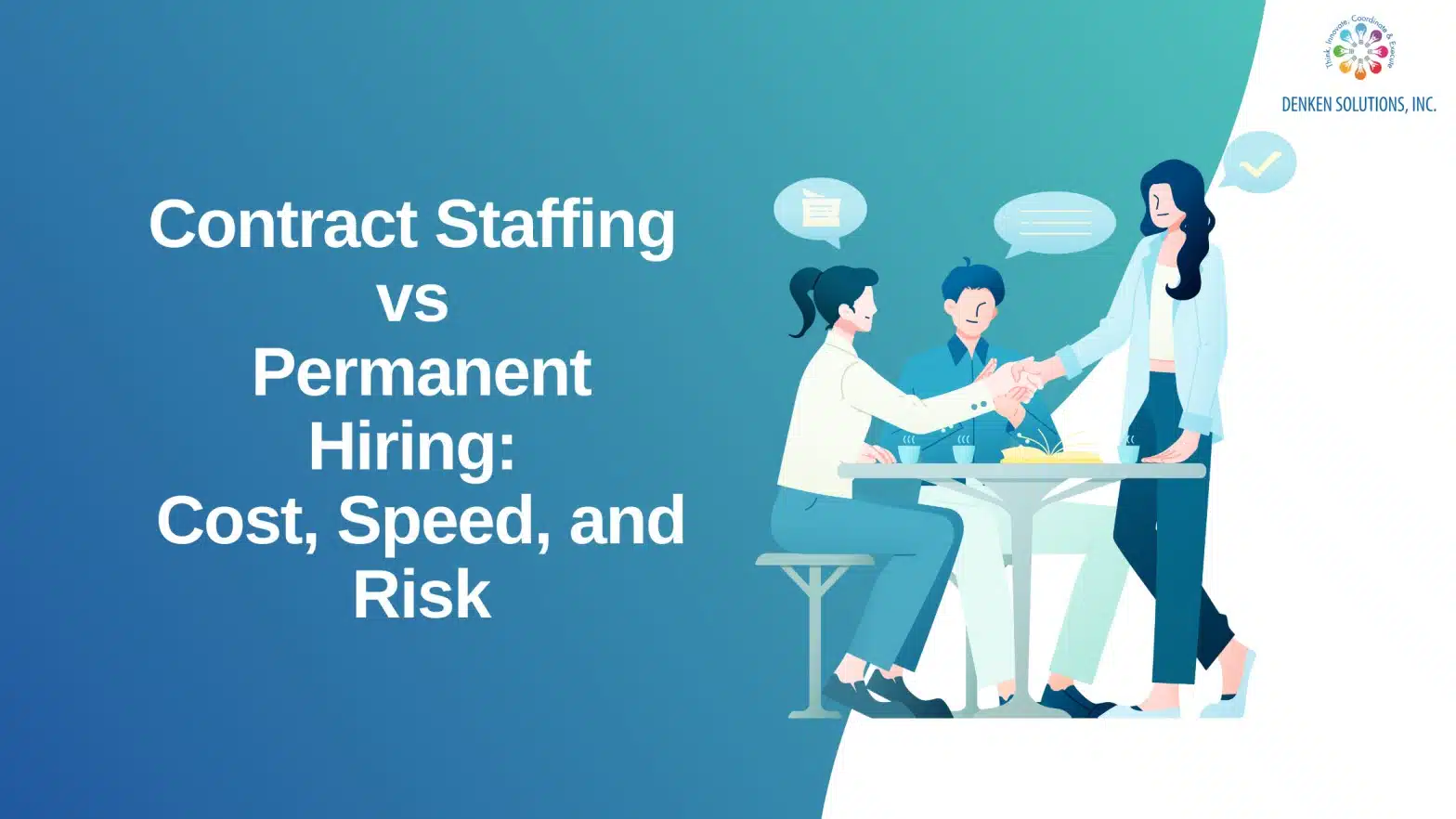
Choosing the correct hiring model is a vital decision for a growing business. While contract staffing and permanent hiring offer distinctive advantages, they also accompany different cost structures, hiring timelines, and risk factors. Understanding these differences is vital for making workforce decisions that align with business goals.
This blog also summarizes contract staffing vs permanent hiring through the lens of cost, risk, and speed. By comparing the two models, businesses can identify which approach offers greater flexibility, quicker access to talent, and better control over long-term workforce commitments.
What is contract staffing?
Contract staffing is a hiring model in which businesses engage professionals for a fixed period or a specific project rather than offering permanent employment. These professionals are employed on a contract basis, thus allowing organizations to access skilled talent without any long-term hiring commitments.
This model is usually used when companies want to scale teams quickly, fill skill gaps, handle seasonal workloads, and support short-term projects. The contract-hiring model offers flexibility in workforce planning while helping businesses control hiring costs and reduce employment-related risks.
By using contract staffing, organizations can focus on productivity and project delivery while minimizing the administrative overhead associated with permanent hiring, such as long-term benefits, retention challenges, and payroll complications.
Read our blog on effective resume strategies for contingent workers.
What is permanent hiring?
Permanent hiring is a traditional employment model in which businesses hire professionals for long-term roles. Permanently hired employees become part of the company’s core workforce and are usually offered fixed salaries, benefits, and long-term career growth opportunities.
This hiring approach is usually used for vital roles that support ongoing business operations, require in-depth organizational knowledge, or play a strategic role in long-term planning. Permanent hiring assists in building workforce stability, team continuity, and strong alignment with the company’s culture.
While permanent hiring offers retention benefits and consistency, it also entails higher long-term costs and longer hiring timelines due to recruitment, onboarding, compliance requirements, and benefits. Businesses must carefully evaluate permanent workforce costs when planning long-term hiring strategies.
Overall comparison: contract staffing vs permanent hiring
Contract staffing and permanent hiring vary significantly in terms of speed, cost, flexibility, and risk. The comparison below highlights how each model performs across key workforce factors, helping businesses choose the right approach based on their hiring needs and long-term goals.
| Factor | Contract staffing | Permanent Hiring |
| Hiring Speed | Faster deployment with shorter hiring cycles | Longer hiring timelines due to multiple interviews and approval stages |
| Cost Structure | Pay for skills on a short-term or project basis | Ongoing salary, benefits, and long-term employment costs |
| Workforce Flexibility | Easy to scale teams up or down based on demand | Limited flexibility once roles are filled |
| Hiring Risk | Lower long-term risk due to fixed contract duration | Higher risk if the hire is not a long-term fit |
| Compliance Burden | Reduced employer responsibility depending on the model | Full compliance responsibility lies with the employer |
| Skill Specialization | Ideal for niche or project-specific expertise | Better suited for core, long-term roles |
| Onboarding Time | Shorter onboarding focused on immediate productivity | More extensive onboarding and training are required |
What are the risk factors to consider?
Choosing between contract staffing and permanent hiring involves a lot more than just cost and speed. Every model carries certain risk factors that businesses should evaluate to avoid any operational, financial, and legal challenges.
1. Employment and compliance risk:
Incorrect worker classification, contract terms, or non-compliance with labor laws can result in penalties and legal exposure. Contract staffing needs clear agreements, while permanent hiring places complete compliance responsibility on the employer.
2. Performance risk and talent fit:
A poor hiring decision can directly impact productivity and team morale. Contract staffing reduces long-term exposure if a role or skill set will not align, whereas permanent hiring increases the cost and impact of mis-hires.
3. Workforce continuity risk:
Contract roles usually involve shorter engagement periods, which can affect knowledge transfer and project continuity if not appropriately handled. Permanent hiring usually offers stability but limits flexibility when the business requires change.
4. Risk of cost overrun:
If planning is not in line with demand, unforeseen costs like more extended contracts, overtime, benefits, training, or replacement recruiting can raise workforce costs in both models.
Which hiring model is right for your business?
Choosing between contract staffing and permanent hiring depends on your business goals, risk tolerance, and workload patterns. There is not one approach that is suitable for everyone; the right model is the one that aligns with how the organization glows and operates.
1. When contract staffing fits your business needs:
Contract staffing is ideal when the business needs flexibility, specialized skills, and speed. It works great for short-term projects, urgent role requirements, or seasonal demand that requires niche expertise without any long-term commitment. This model enables businesses to scale teams quickly while also keeping costs and hiring risks under control.
2. When permanent hiring is the better choice:
Permanent hiring is best suited for core roles that are important for long-term operations and business continuity. It supports workforce stability, in-depth organizational knowledge, and a strong cultural alignment. Companies usually choose permanent hiring for leadership roles or functions that need sustained ownership and long-term planning.
3. A balanced approach:
Various businesses adopt a hybrid workforce model by using contract staffing for flexibility and permanent hiring for stability. This approach helps balance costs, risks, and speed while also maintaining operational continuity.
How does Denken Solutions help businesses find the right contract staff?
Finding the correct contract staff requires accuracy, speed, and the proper screening process. Denken Solutions helps businesses quickly access skilled contract professionals while reducing hiring risk and operational complications.
1. Understanding the requirements:
We assess your business needs, project scope, timelines, and skills to ensure accurate role alignment.
2. Targeted talent sourcing:
Candidates are sourced from verified talent pools and professional networks.
3. Structured screening:
Every candidate is evaluated for experience, technical skills, and communication fit.
4. Client interview support:
Shortlisted profiles are shared for final feedback and interviews.
5. Assists with compliance:
Contracts and engagements are handled in accordance with applicable regulations.
6. Ongoing support:
We provide constant support throughout the contract period to ensure smooth engagement.
Conclusion:
Contract staffing and permanent hiring serve different business needs, and the right choice depends on how the organization balances costs, risk, and speed. Contract staffing offers faster hiring, flexibility, and improved cost control for short-term or specialised requirements. In contrast, permanent hiring provides stability, long-term continuity, and deeper organizational alignment for core roles.
For multiple businesses, a combined approach delivers the best results, thus using contract staffing to stay agile and permanent hiring to build a stable foundation. By understanding these workforce needs, project timelines, and risk tolerance, organizations can adopt a hiring strategy that supports efficiency, growth, and long-term success.